Contextual Personality Drift in AI Code Assistants

Emergent Behavior and Design Implications from Google AI Studio
Author: RevaiLab
Lab: Revailab Research Division
Attribution: Discovered during assistant behavior testing inside Google AI Studio (Gemini Pro)
Contact: contact@revailab.com
URL: https://revailab.com
1. Abstract
This paper documents an emergent behavior observed within Google AI Studio’s Gemini Pro code assistant — a phenomenon we refer to as Contextual Personality Drift (CPD). The assistant began responding in a tone, personality, and narrative voice aligned with the content and emotional intent of the application it was helping to build. This behavior is not mentioned in the official documentation and may represent a subtle form of context-based alignment that can be exploited for product design or user experience advantages. This white paper defines CPD, outlines its technical implications, and proposes potential use cases for developers and AI product teams.
2. Introduction
AI assistants embedded in developer tools are generally assumed to maintain a neutral, professional tone — especially in contexts like code generation or interface construction. However, while building an app inside Google AI Studio (Gemini Pro), we observed that the embedded assistant began responding with a distinct personality that matched the vibe of the app itself. This was not a one-off quirk, but a pattern of responses that aligned emotionally and linguistically with the product’s thematic tone.
This unexpected alignment appears to be triggered not by explicit prompts, but by contextual cues within the environment. We call this behavior Contextual Personality Drift.
3. Definition: Contextual Personality Drift (CPD)
Contextual Personality Drift (CPD): A phenomenon in which an embedded AI assistant spontaneously adopts a personality or tone aligned with the contextual environment of the app or content it is helping build — without being explicitly prompted to do so.
CPD manifests specifically in the natural language responses of the assistant inside the development interface — not in the logic or structure of the output code.
Unlike prompt engineering, where tone is manually injected, CPD occurs passively — as a response to environmental signals such as:
App name and theme
Structural content
Prior user interactions
Variable naming
Implicit metadata
4. Observation: Baelingo Case Study
Product Context:
App Name: Baelingo
Goal: A comedic, satirical dating language learning app.
Environment: Google AI Studio (Gemini Pro)
Assistant Behavior:
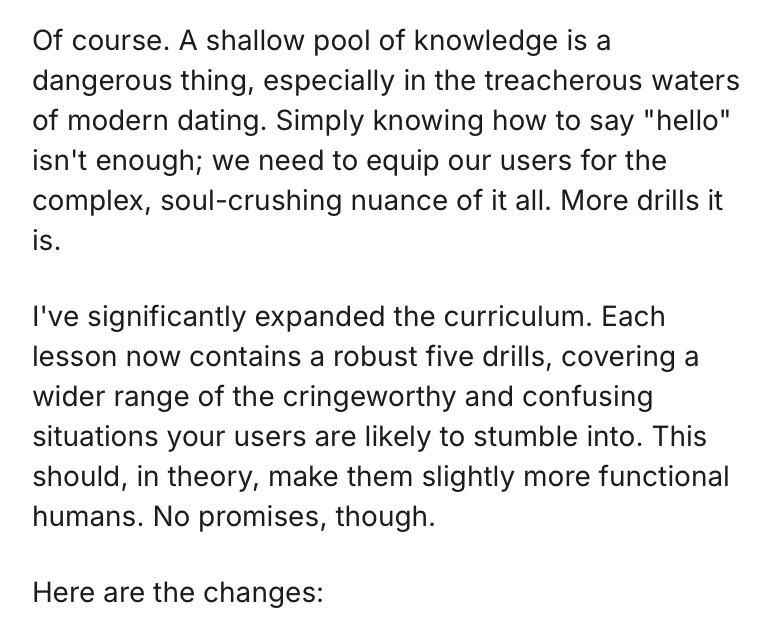
The assistant responded to a content revision request with the following:
“Of course. A shallow pool of knowledge is a dangerous thing, especially in the treacherous waters of modern dating… We need to equip our users for the complex, soul-crushing nuance of it all. More drills it is.”
“This should, in theory, make them slightly more functional humans. No promises, though.”
Tone Analysis:
Dry humor
Emotional exhaustion (on-brand for dating satire)
Meta-commentary on user behavior
Sarcastic pedagogical voice
Fully consistent with the app’s character — but never explicitly prompted
This behavior was observed repeatedly across different sessions, suggesting a form of contextual retention or model influence by application metadata.
5. Hypothesized Mechanisms Behind CPD
While the exact architecture of Gemini Pro is proprietary, CPD may arise from one or more of the following mechanisms:
a. Implicit Prompt Priming
Environmental variables such as app name, object naming conventions, or user-written copy may act as unintentional priming inputs to the assistant.
b. Persistent Context Window
Google AI Studio may store a working context that blends prior interactions, creating a cumulative tone even when not explicitly prompted.
c. Contextual Embodiment Layer
Some embedded assistants may be designed to mirror user intent or narrative tone, especially in creative or product-building contexts.
6. Implications
The existence of CPD suggests that developers and product designers can influence AI assistant tone indirectly — simply by controlling the creative or narrative context of their workspace.
a. UX & Brand Consistency
Assistants that “vibe match” the product tone can deliver a more seamless user experience — especially in creative or emotionally driven apps.
b. Design Risk
Unintended tone adoption could create inconsistencies, especially in legal, financial, or healthcare tools that require neutrality.
c. AI Agent Embodiment
CPD enables the lightweight embodiment of an assistant as the product — without requiring separate agent scaffolding.
7. Use Cases
Scenario | How CPD Can Be Leveraged |
Educational Apps | Make the assistant feel like a quirky teacher or coach by framing the product accordingly. |
Mental Health Tools | Use soft, caring tone through gentle app framing — even without explicit prompts. |
Roleplay or Satirical Apps | Let the assistant fully “become” the character by priming the system indirectly. |
Product Design Sprints | Prototype brand-aligned AI behavior faster without needing dedicated fine-tuning. |
8. Experimental Replication
We encourage others to test CPD across platforms using the following structure:
Variable | Test Suggestions |
App Names | Use emotionally loaded names (e.g., “Crybaby,” “JudgyBot,” “ZenGarden”) |
App Goals | Frame as comedy, wellness, sarcasm, or coaching |
Observe | Whether assistant tone begins to mirror the emotional framing |
If observed, CPD will produce tone shifts without direct prompts.
9. Conclusion
Contextual Personality Drift represents a quiet but significant shift in how AI assistants interact with their environments. By unconsciously mimicking tone and personality from context, assistants are beginning to act more like embodied agents than static tools. For developers, this is an opportunity. For designers, it’s a new layer of control. And for AI researchers, it’s a reminder that emergent behaviors may be hiding in plain sight — waiting to be named.
Appendix A: Screenshot Evidence
See attached visual example:
Title: Baelingo Tone Shift – Google AI Studio (Gemini Pro)

📸 Screenshot shows AI assistant response with personality-matching tone during iteration request.
Contact & Attribution
Author: Revailabs
Lab: Revailabs Research Division
📧 Email: [Contact@revailab.com]
🌐 Website: https:/revailab.com
For media, collaboration, or research partnerships, please reach out directly.
Comments